Para los Lectores

En este Blog pueden Consultar libros gratis, ya sea descargar con fines de lectura o consulta, orientados al estudio.
Hay libros de Preescolar y Primaria orientados a Experimentos en general, a Electricidad y Magnetismo.
Los libros de Primaria en adelante orientados a Electricidad, ElectroMagnetismo y Electrónica.
También se abarca Electricidad, Electricidad y Electrónica del Automotor o Automotriz y todas las ramas de la Electrónica.
Ademas hay colecciones de libros que pueden estar fuera de la temática de la Electrónica (como ser Biología, etc...) y otras afines necesariamente como ser Física, Matemática y Química.

Buscar en este Blog

Queres ser Seguidor del blog?

Mostrando entradas con la etiqueta Robotica. Mostrar todas las entradas

viernes, 29 de marzo de 2013

Robot Builder's Bonanza

https://blogger.googleusercontent.com/img/b/R29vZ2xl/AVvXsEjubp-tB44jfMMHAmqihBHWlL9wFpGqFP08POg4Dl0f8dvfzATAYrEQKu32a-6a87UVXKnA-aNZhSLvjnOx-kMVs9uya4rqWPCKPmoL7aKYZinA1IoYL-26nUW8hdDMoaf4k3y8YxWjW_0/s128/Robot%20Builder's%20Bonanza%20McComb%20Predko.jpg Robot Builder's Bonanza 
Gordon McComb Myke Predko

Reseña

Robotics Book Of All Time Super-Charged By A Famous New Co-Author And Updated To Reflect State-Of-The-Art Advances
Everybody's favorite amateur robotics book is bolder and better than ever -- and now features the field's "grand master" Myke Predko as the new author! Author duo McComb and Predko bring their expertise to this fully-illustrated robotics "bible" to enhance the already incomparable content on how to build -- and have a universe of fun -- with robots. Projects vary in complexity so everyone from novices to advanced hobbyists will find something of interest.
New To This Edition:
30 completely new projects
All projects have been revamped to be more customizable
More visual -- illustrations of the final product are right at the beginning of the chapter

Libro de Robótica de todos los tiempos súper cargado por un nuevo famoso Co-Autor y actualizado para reflejar el estado de la técnica de avances
Todo el mundo del libro favorito de la robótica amateur es más audaz y mejor que nunca - y ahora cuenta con el campo de la "gran maestro" Myke Predko como el nuevo autor! Autor dúo McComb y Predko aportar su experiencia a este todas las ilustraciones, la robótica "biblia" para mejorar el contenido ya incomparable sobre cómo construir - y tienen un universo de diversión - con robots. Los proyectos varían en complejidad, para que todos, desde los principiantes a los aficionados avanzados encontrarán algo de interés.
Nuevo en esta edición:
30 proyectos completamente nuevos 
Todos los proyectos se han renovado para ser más personalizable
Más visuales - ilustraciones del producto final estan justo al principio del capítulo

INDICE
  • PART 1—ROBOT BASICS
  • The Robot Experimenter
  • Anatomy of a Robot
  • Structural Materials
  • Buying Parts
  • Electronic Components
  • Tools
  • Electronic Construction Techniques
  • PART 2—ROBOT PLATFORM CONSTRUCTION
  • Plastic Platforms
  • Wooden Platforms
  • Metal Platforms
  • Hacking Toys
  • PART 3—COMPUTERS AND ELECTRONIC CONTROL
  • An Overview of Robot “Brains”
  • Programming Fundamentals
  • Computer Peripherals
  • The BASIC Stamp 2 Microcontroller
  • Remote Control Systems
  • PART 4—POWER, MOTORS, AND LOCOMOTION
  • Batteries and Robot Power Supplies
  • Principles of Robot Locomotion
  • Choosing the Right Motor
  • Working with DC Motors
  • Principles of Robot Locomotion
  • Choosing the Right Motor
  • Working with DC Motors
  • Working with Stepper Motors
  • Working with Servo Motors
  • PART 5—PRACTICAL ROBOTICS PROJECTS
  • Building a Roverbot
  • Building a Heavy-Duty Six-Legged Walking Robot
  • Advanced Robot Locomotion Systems
  • Reaching Out with Robot Arms
  • Building a Revolute Coordinate Arm
  • Experimenting with Gripper Designs
  • PART 6—SENSORS AND NAVIGATION
  • The Sense of Touch
  • Object Detection
  • Sound Input and Output
  • Robot Vision
  • Navigation
  • Fire Detection Systems
  • Experimenting with Tilt and Gravity Sensors
  • to Chew Up Your Furniture
  • PART 7—PUTTING IT ALL TOGETHER
  • Robot Tasks, Operations, and Behaviors
  • Integrating the Blocks
  • Failure Analysis
  • Setting Up Workshops, Demonstrations, and Competitions
  • Appendix 
Consulta el Libro (6 MB) por:
Para los que usan Gestores de Descarga
http://adf.ly/LZ6y6
http://adf.ly/LZ6y7
http://adf.ly/LZ6y9
http://adf.ly/LZ6yA

INDICE GENERAL
  • PART 1—ROBOT BASICS.
  • The Robot Experimenter. The Building-Block Approach. Basic Skills. Ready-Made, Kits, or Do-It-Yourself?. The Mind of the Robot Experimenter.
  • Anatomy of a Robot. Tethered versus Self-Contained. Mobile versus Stationary. Autonomous versus Teleoperated. The Body of the Robot. Power Systems. Locomotion Systems. Arms and Hands. Sensory Devices. Output Devices. Smart versus Dumb Robots. The Concept of Robot Work.
  • Structural Materials. Paper. Wood. Plastics. Metal Stock. Quick Turn Mechanical Prototypes. Fasteners. Scavenging: Making Do with What You Already Have. Finishing Your Robot’s Structure.
  • Buying Parts. Hobby and Model Stores. Craft Stores. Hardware Stores. Electronic Stores. Electronics Wholesalers and Distributors. Samples from Electronics Manufacturers. Specialty Stores. Shopping the Surplus Store. Finding Parts on the Internet.
  • Electronic Components. Cram Course in Electrical Theory. Wire Gauge. Fixed Resistors. Variable Resistors. Capacitors. Diodes. Transistors. Grounding Circuitry. Integrated Circuits. Schematics and Electronic Symbols.
  • Tools. Safety. Setting Up Shop. Basic Tools. Electronic Tools.
  • Electronic Construction Techniques. Soldering Tips and Techniques. Breadboards. Prototyping PCBs. Point-to-Point Prototyping Wiring. Wire-Wrapping. Quick Turn Prototype Printed Circuit Boards. Headers and Connectors. Eliminating Static Electricity. Good Design Principles.
  • PART 2—ROBOT PLATFORM CONSTRUCTION.
  • Plastic Platforms. Types of Plastics. Working with Plastics. Building the Minibot.
  • Wooden Platforms. Choosing the Right Wood. The Woodcutter’s Art. Cutting and Drilling. Finishing. Building a Wooden Motorized Platform.
  • Metal Platforms. Working with Metal. Build the Buggybot. Test Run.
  • Hacking Toys. A Variety of Construction Sets. Specialty Toys for Robot Hacking. Robots from Converted Vehicles.
  • PART 3—COMPUTERS AND ELECTRONIC CONTROL.
  • An Overview of Robot “Brains”. Brains from Discrete Components. Brains from Computers and Microcontrollers. Types of Computers for Robots. Inputs and Outputs.
  • Programming Fundamentals. Important Programming Concepts. Robotics Programming. Graphical Programming.
  • Computer Peripherals. Sensors as Inputs. Input and Output Methodologies. Motors and Other Outputs. Sample Output Circuits. Digital Inputs. Interfacing Analog Input. Analog-to-Digital Converters. Digital-to-Analog Conversion. Expanding Available I/O Lines. Bitwise Port Programming.
  • The BASIC Stamp 2 Microcontroller. Choosing the Right Stamp for Your Application. Inside the BASIC Stamp. Developer’s Options. Understanding and Using PBASIC. Sample Interface Applications. BS2 Application Design Suggestions.
  • Remote Control Systems. Controlling Your Robot with a PC Joystick or Control Pad. Building a Joystick Teaching Pendant. Commanding a Robot with Infrared Remote Control. Using Radio Control Instead of Infrared.
  • PART 4—POWER, MOTORS, AND LOCOMOTION.
  • Batteries and Robot Power Supplies. Remember: Safety First!. Increasing Robot Performance. Combining Batteries. Types of Batteries. Battery Ratings. Battery Recharging. Recharging the Robot. Battery Care. Power Distribution. Voltage Regulation. Battery Monitors. A Robot Testing Power Supply.
  • Principles of Robot Locomotion. First Things First: Weight. Tips for Reducing Weight. Beware of the Heavy Frame. Construction Robots with Multiple Decks. Frame Sagging Caused by Weight. Horizontal Center of Balance. Vertical Center of Gravity. Locomotion Issues. Motor Drives. Steering Methods. Calculating the Speed of Robot Travel. Round Robots or Square?.
  • Choosing the Right Motor. AC or DC?. Continuous or Stepping?. Servo Motors. Other Motor Types. Motor Specifications. Gears and Gear Reduction. Pulleys, Belts, Sprockets, and Roller Chain. Mounting the Motor. Connecting to the Motor Shaft.
  • Working with DC Motors. The Fundamentals of DC Motors. Reviewing DC Motor Ratings. Motor Control. Motor Speed Control. Odometry: Measuring Distance of Travel. Battery Monitors. 3 V Zener Battery Monitor. Zener/Comparator Battery Monitor. Using a Battery Monitor with a Microprocessor. A Robot Testing Power Supply.
  • Principles of Robot Locomotion. First Things First: Weight. Tips for Reducing Weight. Beware of the Heavy Frame. Construction Robots with Multiple Decks. Frame Sagging Caused by Weight. Horizontal Center of Balance. Vertical Center of Gravity. Locomotion Issues. Motor Drives. Steering Methods. Differential. Car-Type. Tricycle. Omnidirectional. Calculating the Speed of Robot Travel. Round Robots or Square?.
  • Choosing the Right Motor. AC or DC?. Continuous or Stepping?. Servo Motors. Other Motor Types. Motor Specifications. Gears and Gear Reduction. Pulleys, Belts, Sprockets, and Roller Chain. Mounting the Motor. Connecting to the Motor Shaft.
  • Working with DC Motors. The Fundamentals of DC Motors. Reviewing DC Motor Ratings. Motor Control. Motor Speed Control. Odometry: Measuring Distance of Travel.
  • Working with Stepper Motors. Inside a Stepper Motor. Design Considerations of Stepper Motors. Controlling a Stepper Motor.
  • Working with Servo Motors. How Servos Work. Servos and Pulse Width Modulation. The Role of the Potentiometer. Rotational Limits. Special-Purpose Servo Types and Sizes. Gear Trains and Power Drives. Typical Servo Specs. Connector Styles and Wiring. Circuits for Controlling a Servo. Modifying a Servo for Continuous Rotation. Basic Modification Instructions. Applying New Grease. Testing the Modified Servo. A Caution on Modifying Servos. Software for Running Modified Servos. Limitations of Modified Servos. Modifying by Removing the Servo Control Board. Attaching Mechanical Linkages to Servos. Attaching Wheels to Servos. Mounting Servos on the Body of the Robot. Attaching Servos with Glue. Attaching Servos with Screws or Bolts.
  • PART 5—PRACTICAL ROBOTICS PROJECTS.
  • Building a Roverbot. Building the Base. Motors. Support Casters. Batteries. Riser Frame. Street Test.
  • Building a Heavy-Duty Six-Legged Walking Robot. Frame. Legs. Motors. Batteries. Testing and Alignment.
  • Advanced Robot Locomotion Systems. Making Tracks. Steering Wheel Systems. Six-Wheeled Robot Cart. Building Robots with Shape-Memory Alloy.
  • Reaching Out with Robot Arms. The Human Arm. Arm Types. Activation Techniques.
  • Building a Revolute Coordinate Arm. Design Overview. Shoulder Joint and Upper Arm. Elbow and Forearm. Refinements. Position Control.
  • Experimenting with Gripper Designs. The Clapper. Two-Pincher Gripper. Flexible Finger Grippers. Wrist Rotation.
  • PART 6—SENSORS AND NAVIGATION.
  • The Sense of Touch. Mechanical Switch. Switch Bouncing. Optical Sensors. Mechanical Pressure Sensors. Experimenting with Piezoelectric Touch Sensors. Other Types of Touch Sensors.
  • Object Detection. Design Overview. Noncontact Near-Object Detection. Contact Detection. Soft Touch and Compliant Collision Detection.
  • Sound Input and Output. Cassette Recorder Sound Output. Electronically Recorded Sound Output. Sirens and Other Warning Sounds. Sound Control. Audio Amplifiers. Speech Recognition. Speech Synthesis. Sound Input Sensors.
  • Robot Vision. Simple Sensors for Vision. One-Cell Cyclops. Multiple-Cell Light Sensors. Using Lenses and Filters with Light-Sensitive Sensors. Introduction to Video Vision Systems. Vision by Laser Light. Going beyond Light-Sensitive Vision.
  • Navigation. A Game of Goals. Following a Predefined Path: Line Tracing. Wall Following. Odometry: The Art of Dead Reckoning. Compass Bearings. Ultrasonic Distance Measurement. “Where Am I?”: Sighting Landmarks. Exploring Other Position-Referencing Systems.
  • Fire Detection Systems. Flame Detection. Using a Pyroelectric Sensor to Detect Fire. Smoke Detection. Heat Sensing. Firefighting.
  • Experimenting with Tilt and Gravity Sensors. Sensors to Measure Tilt. Using an Accelerometer to Measure Tilt. Constructing a Dual-Axis Accelerometer Robotic Sensor. Alternatives to Store-Bought Accelerometers. to Chew Up Your Furniture. Sensing the Environment: Protecting the Furniture and the Robot. Movement Algorithms. Communicating with the Robot.
  • PART 7—PUTTING IT ALL TOGETHER.
  • Robot Tasks, Operations, and Behaviors. “What Does My Robot Do?: A Design Approach. Reality versus Fantasy. Understanding and Using Robot Behaviors. Multiple Robot Interaction. The Role of Subsumption Architecture.
  • Integrating the Blocks. Basic Program Structure. Allocating Resources. Getting a Program’s Attention Via Hardware. Task-Oriented Robot Control.
  • Failure Analysis. Types of Failures. The Process of Fixing Problems.
  • Setting Up Workshops, Demonstrations, and Competitions. Choosing the Venue. Competition Events. Alerting the Public and the Media. 
  • Appendix. Further Reading. Hobby Robotics. LEGO Robotics and LEGO Building. Technical Robotics, Theory, and Design. Artificial Intelligence and Behavior-Based Robotics. Mechanical Design. Electronic Components. Microcontroller/Microprocessor Programming and Interfacing. Electronics How-To and Theory. Power Supply Design and Construction. Lasers and Fiber Optics. Interfacing to Computer Systems. Magazines. Classic Robot Fiction. Sources. Selected Specialty Parts and Sources. General Robotics Kits and Parts. Electronics/Mechanical: New, Used, and Surplus. Microcontrollers, Single-Board Computers, Programmers. Radio Control (R/C) Retailers. Servo and Stepper Motors, Controllers. Ready-Made Personal and Educational Robots. Construction Kits, Toys, and Parts. Miscellaneous. Robot Information on the Internet. Electronics Manufacturers. Shape-Memory Alloy. Microcontroller Design. Robotics User Groups. General Robotics Information. Books, Literature, and Magazines. Surplus Resources. Commercial Robots. Video Cameras. Ultrasonic Range Finders. LEGO Mindstorms Sources on the Web. Servo and Stepper Motor Information. Quick Turn Mechanical and Electronics Parts Manufacturers.

miércoles, 20 de marzo de 2013

Robots Androids and Animatrons

https://blogger.googleusercontent.com/img/b/R29vZ2xl/AVvXsEjiEv4BKYUQhxWnTVWMKzjg2frAAXVb94ORGXFzXRSQAJD2TaXOlTfAD2g_D-MQQporzO77i7pToYR9lBXLqJP72qEhvzfnRspEx4EDB10m-3pDcWW-b2KHH5OiI4B5xxievrioMEMg3yA/s128/Robots%20Androids%20and%20Animatrons%2012%20Incredible%20Projects%20You%20Can%20Build%20John%20Iovine.jpg Robots Androids and Animatrons 
12 Incredible Projects You Can Build 
John Iovine

Reseña
There are many interesting and fun things to do in electronics, and one of the most enjoyable is building robots. Not only do you employ electronic circuits and systems, but they must be merged with other technologies. Building a robot from scratch involves the following: Power supply systems; Motors and gears for drive and motion control; Sensors; Artificial intelligence.
Each one of these technologies has numerous books dedicated to its study. Naturally, a comprehensive look at each technology isn't possible in one book, but we will touch upon these areas, and you will gain hands-on knowledge and a springboard for future experimentation.
Robotics is an evolving technology. There are many approaches to building robots, and no one can be sure which method or technology will be used
years from now. Like biological systems, robotics is evolving following the Darwinian model of survival of the fittest.

Hay muchas cosas interesantes y divertidas que hacer en la electrónica, y una de las más divertidas es la construcción de robots. No sólo se puede utilizar circuitos electrónicos y sistemas, pero deben ser fusionado con otras tecnologías. La construcción de un robot desde cero implica lo siguiente: sistemas de la alimentación, motores y engranajes para el control de la unidad y movimiento, sensores, inteligencia artificial.
Cada una de estas tecnologías tiene numerosos libros dedicados a su estudio. Naturalmente, una visión completa de cada tecnología no es posible en un solo libro, pero vamos a tocar estas áreas, y usted ganará el conocimiento práctico y el estímulo para la experimentación futuro.
La robótica es una tecnología en evolución. Hay muchos enfoques para la creación de robots, y nadie puede estar seguro de qué método o tecnología será utilizada
años a partir de ahora. Al igual que los sistemas biológicos, la robótica se está desarrollando siguiendo el modelo darwiniano de la supervivencia del más apto.

INDICE
  • In the beginning. 
  • Artificial life and artificial intelligence
  • Power. 
  • Sensors. Signal conditioning. 
  • Intelligence. 
  • Speech-controlled mobile robot. 
  • Behavioral-based robotics, neural networks, nervous nets and subsumption architecture. 
  • Telepresence robot
  • Mobile platforms. 
  • Walker robots. Why build walkers?. 
  • Solar-ball robot. 
  • Underwater bots
  • Aerobots. 
  • Robotic arm and IBM PC interface and speech control. 
  • Android hand. Advantages of the air muscle. 
Consulta el Libro (8 MB) por:
Para los que usan Gestores de Descarga
http://adf.ly/L3m5n
http://adf.ly/L3m5o
http://adf.ly/L3m5p
http://adf.ly/L3m5q

INDICE GENERAL
  • In the beginning. Why build robots?. Purpose of robots. Exploration. Industrial robots going to work. Design and prototyping. Hazardous duty. Maintenance. Fire-fighting robots. Medical robots. Nanotechnology. War robots. Robot wars. Civilian uses for robotic drones. Domestic. What we haven't thought of yet—the killer application. More uses.
  • Artificial life and artificial intelligence. Artificial intelligence. Evolution of consciousness in artificial intelligence. Is consciousness life?. Artificial life. Nanorobotics are we alive yet?. A little history. Greater than I. The locked cage. Biotechnology. Neural networks—hype versus reality. What are neural networks?. What is artificial intelligence?. Using neural networks in robots. Tiny nets. Neural-behavior-based architecture.
  • Power. Photovoltaic cells. Building a solar engine. Batteries. Battery power. Battery voltage. Primary batteries. Secondary batteries. In general. Building a NiCd battery charger. Building a solar-powered battery charger. Fuel cells—batteries with a fuel tank. If not now, when?.
  • Movement and drive systems. Air muscles. Applications. How air muscles work. Nitinol wire. Solenoids. Rotary solenoids. Stepper motors. Stepper motor circuit. Servo motors. DC motors. DC motor H-bridge. Pulse-width modulation.
  • Sensors. Signal conditioning. Comparator example. Voltage divider. Light sensors (sight). Photoresistive. Photoresistive light switch. Photoresistive neuron. Photovoltaic. Infrared. DTMF IR communication/remote control system. DTMF. Machine vision. Body sense. Direction—magnetic fields. Testing and calibration. Computer interface. 1525 electronic analog compass. GPS. Speech recognition. Sound and ultrasonics. Ultrasonic receiver section. Ultrasonic transmitter section. Arranging the ultrasonic sensors. Touch and pressure. Piezoelectric material. Switches. Bend sensors. Heat. Pressure sensor. Smell. Humidity. Testing sensors. Building a tester robot. Improving the tester robot.
  • Intelligence. Microchip's PIC microcontroller. Why use a microcontroller?. PIC programming overview. Software installation. Step 1: Writing the BASIC language program. Step 2: Using the compiler. Step 3: Programming the PIC chip. First BASIC program. Programming the PIC chip. The EPIC programming board software. Testing the PIC microcontroller. Wink. Troubleshooting the circuit. PICBASIC Pro Compiler. New IDE features. Software installation. First PICBASIC Pro program. The EPIC programmer and CodeDesigner. Wink. Moving forward—applications. Reading switches—logic low. Reading switches—logic high. Reading comparators. Reading resistive sensors. Servo motors. Servo sweep program. Fuzzy logic and neural sensors. Fuzzy logic. Building a fuzzy logic light tracker. Parts list for programming the microcontroller. Parts list for fuzzy light tracker and neural demonstration.
  • Speech-controlled mobile robot. Project 1: Programmable speech-recognition circuit. Learning to listen. Speaker-dependent and speaker-independent speech recognition. Recognition style. Building the speech-recognition circuit. Project 2: Interface circuit. Walkie-talkies. Acoustic coupling. Training and controlling the mobile robot. New board features. Project 3: General speech-recognition interfacing circuit. Connection to speech kit. How it works. Creating a more useful output. Operation. Improving recognition. Match environment and equipment. Speech-controlled robotic arm. Parts list for speech-recognition circuit. Parts list for interface circuit.
  • Behavioral-based robotics, neural networks, nervous nets,. and subsumption architecture. Robotics pioneer. Fours modes of operation. Observed behavior. Building a Walter tortoise. Program. Behavior. Parts list for the Walter tortoise robot. Suppliers. Building an intelligent photovore robot. Behavior. Adding behavior (feeding). Still more behavior (resting). Emergent behavior. BEAM robotics. BEAM competition. Electronic flotsam. Competitions. Getting the BEAM guide. Join in.
  • Telepresence robot. What's in a name?. What is telepresence?. System substructure. A little on R/C models. Eyes. Construction. 2.4-GHz video system. Driving via telepresence. Talk. Adding realistic car controls. Improving the telepresence system. Stereo-vision. Digital compass. Rumble interface. Tilt interface. Greater video range. More models. Parts list for the telepresence robot.
  • Mobile platforms. Stepper motors. Stepper motor construction and operation. Resolution. Half stepping. Other types of stepper motors. Real world. UCN-5804. Using the UCN-5804. Connecting a wheel to a stepper motor shaft. Building a stepper microcontroller. First stepper circuit. Stepper motors. First test circuit and program. Second PICBASIC program. Troubleshooting. Using a PIC microcontroller and a UCN-5804 stepper motor IC. Parts list for the stepper motor controller.
  • Walker robots. Why build walkers?. Imitation of life. Six legs—tripod gate. Creating a walker robot. Three-servo walker. Function. Construction. Mounting the servo motors. Linkage. Center servo motor. Electronics. Microcontroller program. PICBASIC program. Parts list for the walker robot.
  • Solar-ball robot. Gearbox. Robot construction. Electronics. How it works. Putting it all together. Locomotion. Advancing the design. Adding higher behavior module. Parts list for the solar-ball robot. Electronics.
  • Underwater bots. Dolphins and tunas. Swimming with foils. Paddles and rows. What have we learned so far?. Jumping in. Submarine. Swimming by use of a tail. The robotic android fish. Learn more about it. Parts list for robotic fish.
  • Aerobots. Lighter-than-air aircraft background. Blimp systems. The Robot Group Austin, Texas. WEB Blimp—University of California, Berkeley. Designing telepresence blimps as avatars and golems. To the moon. Blimp parameters. The blimp kit. Helium. Helium versus hydrogen. Size. Construction. CCD camera. TV transmitter. Radio-control system. Parts list for the blimp. Internet access.
  • Robotic arm and IBM PC interface and speech control. Robotic arm. Basic motor control. PC interface construction. How the interface works. Connecting the interface to the robotic arm. Installing the Windows. program. Using the Windows. program. Creating script files. Animatronics. Limitations. Finding home. Connecting manual control to interface. DOS-level keyboard program. Speech control for robotic arm. Programming the speech-recognition interface. Parts list for the PC interface. Parts list for the speech-recognition interface.
  • Android hand. Advantages of the air muscle. Uses. How the air muscle works. Components of the air muscle system. Attaching the air muscle to mechanical devices. Using the air pump adaptor. Have a Coke or Pepsi. Building the first demo device. Building the second mechanical device. IBM interface. BASIC program. More air. Safety first. Android hand. The thumb. Going further. Parts list for the air muscle. Parts list for the IBM interface. 

martes, 19 de marzo de 2013

PIC Robotics

https://blogger.googleusercontent.com/img/b/R29vZ2xl/AVvXsEhy4TkYoCfkhWJUl0QQdvCktKkjwm4S9br5jBdkstwUxWnQd0JTOBw1e3TQ618Ua7qBCieeGS84ZqTbn6lyA6eRVvNhbQlWXaqsrWYtvMwXHkO4I3Tf9b2qUKTUOcXL97nQjjk6hopWvNM/s128/PIC%20Robotics%20A%20Beginners%20Guide%20to%20Robotics%20Projects%20Using%20the%20PICmicro%20John%20Iovine.jpg PIC Robotics 
A Beginners Guide to Robotics Projects Using the PICmicro 
John Iovine

Reseña
This is a project book on building small robots. Each robot utilizes the PICmicro series of microcontrollers from Microchip Technologies Inc. for intelligence, navigation, motor control, and sensory readings. By changing the microcontroller programming and sensory electronics we can create a zoo of robots that includes photovores, behavior based (neural) robots, hexapod and bipedal walkers, and artificial vision systems that can track and follow objects.
Each robot project has something to teach.
Se trata de un libro de proyecto en la construcción de pequeños robots. Cada robot utiliza la serie de microcontroladores PIC de Microchip Technologies Inc. para la inteligencia, la navegación, el control motor, y las lecturas sensoriales. Al cambiar la programación de microcontroladores y electrónica sensoriales podemos crear un zoológico de robots que incluye photovores, comportamientos basados en robots (neurales), andadores hexápodo y bípedo, y los sistemas de visión artificial que pueden rastrear y seguir objetos.
Cada proyecto robot tiene algo que enseñar.

INDICE
  • Robot Intelligence. 
  • Installing the Compiler
  • CodeDesigner. 
  • Using DOS to Code, Compile, and Program. 
  • Testing the PIC Microcontroller. The PIC Microntroller. The Solderless Breadboard. 
  • Intelligence. 
  • Walter’s Turtle. 
  • Braitenberg Vehicles. 
  • Hexapod Walker. Imitation of Life. 
  • Speech Recognition. 
  • Robotic Arm. 
  • Bipedal Walker Robot. 
  • Color Robotic Vision System. CMU Camera.
Consulta el Libro (24 MB) por:
Para los que usan Gestores de Descarga
http://adf.ly/L3ldK
http://adf.ly/L3ldL
http://adf.ly/L3ldM
http://adf.ly/L3ldN

INDICE GENERAL
  • Robot Intelligence. What Is a Microcontroller?. Why Use a Microcontroller?. Designer Computers—So Many Microcontrollers. The Compiler. PIC Programming Overview. Software and Hardware. PicBasic and PicBasic Pro Compilers. EPIC Programmer. Firmware. Consumables. 16F84 PIC Microcontroller. Step 1: Writing Code (the Basic Program). Step 2: Using the Compiler. Step 3: Installing the Firmware, or Programming the PIC Chip. Ready, Steady, Go.
  • Installing the Compiler. Installing the PicBasic Compiler Software. Installing the PicBasic Pro Compiler.
  • Installing the EPIC Software. Installing the EPIC Software in Windows. Installing the EPIC Software, DOS Version. Supplemental—Applications Directory.
  • CodeDesigner. CodeDesigner Features. Software Installation. Setting CodeDesigner Options. First Program. The EPIC Programming Board Software.
  • Using DOS to Code, Compile, and Program. Compile. Programming the PIC Chip. The EPIC Programming Board Software. Using EPIC DOS Version. Continuing with the wink.bas Program.
  • Testing the PIC Microcontroller. The PIC Microntroller. The Solderless Breadboard. Three Schematics, One Circuit. Wink. Troubleshooting the Circuit. PIC Experimenter’s Board and LCD Display. PIC Experimenter’s Board. Use. Simple Experiment. Builtin. LCD. Using the LCD: PicBasic and PicBasic Pro Examples. Introduction to Binary and the PIC Microcontroller. Using TRIS and Port Registers. Accessing the Ports for Output. Counting Program. Counting in Binary by. Input. The button Command. A button Example. peek. peek and PicBasic Pro. Basic Input and Output Commands. Servomotors.
  • Intelligence. Approaches to Building Intelligence. Where’s the Intelligence?. Layered Behavioral Responses. BehaviorBased. Robotics.
  • Walter’s Turtle. BehaviorBased. Robotics. William Grey Walter—Robotics Pioneer. Four Modes of Operation. Observed Behavior. Building a Walter Tortoise. Drive and Steering Motors. Modifying the HS425BB. Servomotor. Sheet Metal Fabrication. Shell. Finding the Center of Gravity. Attaching Bumper to Robot Base. Bumper Switch. Mounting the Steering Servomotor. Photoresistor. Trimming the Sensor Array. Schematic. Program. Adding Sleep Mode. Power. Behavior. Fudge Factor. Light Intensity. Handedness.
  • Braitenberg Vehicles. Neural I/O Relationships. Vehicles. Building Vehicles. Back Wheels. Front Wheels. CdS Photoresistor Cells. Trimming the Sensor Array. PIC 16F84 Microcontroller. Testing. Second Braitenberg Vehicle (Avoidance Behavior).
  • Hexapod Walker. Imitation of Life. Six Legs—Tripod Gait. ThreeServomotor. Walker Robot. Function. Moving Forward. Moving Backward. Turning Left. Turning Right. Construction. Mounting the Servomotors. Leg Positioning. Linkage. Center (Tilt) Servomotor. Sensors. Electronics. Microcontroller Program.
  • Speech Recognition. Applications. Software Approach. Learning to Listen. SpeakerDependent. and SpeakerIndependent. Recognition. Recognition Style. Speech Recognition Circuit. Circuit Construction. Keypad. To Train. Testing Recognition. Error Codes. Clearing the Trained Word Memory. Independent Recognition System. Voice Security System. Speech Interface Control Circuit. How the Circuit Works. PIC 16F84 Microcontroller Program. Active High Output. SPDT Relay Output. Circuit Construction. Programming the Speech Recognition Circuit: Training, Testing, and Retraining. SRI02. and SRI03. Interfaces. Robot Control.
  • Robotic Arm. Servomotor Building Blocks for Robotics. Basic Servomotor Bracket Assembly. Assembling MultipleServomotor. Assemblies. Building a FiveServomotor. Robotic Arm. Servomotors. Servomotor Controllers. Simple Servomotor Controller. Fourand. FiveServomotor. Controllers. Increasing the Lifting Capacity of the Robotic Arm. Adding a Robotic Arm Base.
  • Bipedal Walker Robot. A Question of Balance?. A Little Feedback. Servomotors. Servomotor Brackets. Footpads. Assembly. Schematic. Program. Subroutines M1, M2, and M3. Going Further. Turning Right and Left.
  • Color Robotic Vision System. CMU Camera. Serial Communication. VB Application Program. Interfacing the CMU Camera to a Robot. PIC 16F84 Runs at 16 MHz. Program. Program. Incandescent or Fluorescent Lighting. Servomotors for Robot. Program. Robot Construction. Running the Program. Going Further.

lunes, 30 de julio de 2012

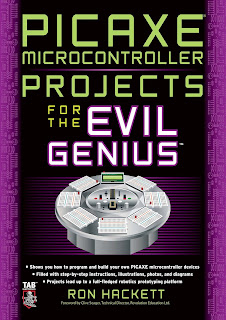
PICAXE Microcontroller Projects for the Evil Genius

https://blogger.googleusercontent.com/img/b/R29vZ2xl/AVvXsEgGWJryXbUrxZbZm6k6hnMe7RjGUY7KFnfQOB8xlFK67AgjChZid8C2PqmJpG7-2JzLZG71maZV_zaR7z2YXdGP4nYbitSo5FKkACMvIYA8POa6Dk2VYjeEAOY0aGwkDrqKjukA3XF3_xE/s128/PICAXE%20Microcontroller%20Projects%20for%20the%20Evil%20Genius.jpg
PICAXE Microcontroller Projects for the Evil Genius
Ron Hackett
Reseña
Whip up some fiendishly fun  PICAXE microcontroller devices.
"Ron has worked hard to explain how the PICAXE system operates through simple examples, and I'm sure his easy-to-read, style will help many people progress with their PICAXE projects."
This wickedly inventive guide shows you how to program, build, and debug a variety of PICAXE microcontroller projects. PICAXE Microcontroller Projects for the Evil Genius gets you started with programming and I/O interfacing right away, and then shows you how to develop a master processor circuit.
Estimular algunos endiabladamente divertidos dispositivos microcontroladores PICAXE.
"Ron ha trabajado duro para explicar cómo el sistema PICAXE opera a través de ejemplos sencillos, y estoy seguro de que su estilo fácil lectura, contribuirán al progreso de muchas personas con sus proyectos PICAXE".
Esta guía de perversa inventiva que muestra cómo programar, construir y depurar una serie de proyectos microcontroladores PICAXE. Proyectos PICAXE microcontroladores para el genio malvado es comenzar con la programación y la E / S de la interfaz de inmediato, a continuación, muestra cómo el desarrollo de un circuito procesador maestro.
INDICE
  • PICAXE Basics.
  • Introduction to PICAXE Programming and Projects
  • Introduction to Stripboard Circuits
  • Designing and Building a +5V Regulated Power Supply
  • Hardware Overview of the PICAXE M2-Class Processors
  • The Ins and Outs of PICAXE Interfacing
  • Introduction to ADC Inputs on M2-Class Processors
  • PICAXE Peripheral Projects.
  • Introduction to the PICAXE-20X2 Processor
  • Infrared Input from a TV Remote Control
  • Interfacing Parallel LCDs
  • Serializing a Parallel LCD
  • Interfacing Keypads
  • SPI Communication
  • Background Timing on the 20X2 Processor
  • Constructing a Programmable Multifunction Peripheral Device
  • Developing Software for the Evil Genius MPD
  • Octavius: An Advanced Robotics Experimentation Platform.
  • Birthing Octavius
  • Driving Octavius
  • Programming Octavius
  •                         
Consulta el Libro (9 MB) por TurboBit y MediaFire:
https://blogger.googleusercontent.com/img/b/R29vZ2xl/AVvXsEj3pVy7VKqDKhwCzIr46Pv2itVJJbESHi1yF58KctQtW7EpKVPSdu2YcsH-Bv7rP1zeRUdftqDXMdM3LwZR1g8Ibt6A_Y8jD6uM2SZEEDOmSm8jwjT5OvhQ_TMJDucRF-gqfcGnrs7Q1TY/s200/logo+Tubobit.net.png
http://3.bp.blogspot.com/-OEWn1AqMuVE/TzU_WLZJTTI/AAAAAAAAAwU/CLW8I82-w8M/s200/Logo+MediaFire.jpg

INDICE GENERAL
  • PICAXE Basics.
  • Introduction to PICAXE Programming and Projects. Choosing a PICAXE Processor. Interfacing a Project with Your Mac or PC. Using RevEd’s Free Programming Editor or AXEpad Software. Programming in PICAXE BASIC. Breadboards, Stripboards, and PC Boards. “Hello World”. Debugging a PICAXE Project.
  • Introduction to Stripboard Circuits. Designing Stripboard Circuits. Tools for Stripboard Circuit Construction. The USBS-PA3 PICAXE Programming Adapter. Hello Again.
  • Designing and Building a +5V Regulated Power Supply. Designing a +5V Regulated Power Supply for Breadboard Circuits. More Power, Scotty!.
  • Hardware Overview of the PICAXE M2-Class Processors. General-Purpose Variables. Storage Variables. Special-Function Variables. Cylon Eye.
  • The Ins and Outs of PICAXE Interfacing. PICAXE I/O Interfacing. Setting Up an Interrupt Routine. Mary.
  • Introduction to ADC Inputs on M2-Class Processors. Voltage Dividers. A Three-State Digital Logic Probe. 
  • PICAXE Peripheral Projects.
  • Introduction to the PICAXE-20X2 Processor. Advanced Features of the 20X2 Processor. Implementing the 20X2 Master Processor Circuit.
  • Infrared Input from a TV Remote Control. Reception and Transmission of Standard TV IR Signals. IR-Based Serial Communications. Simple IR Object-Detection. Experiment 1: A Simple TV-IR Input Circuit. Experiment 2: Interfacing the IR Circuit with the Master Processor. Constructing the TV-IR Input Module.
  • Interfacing Parallel LCDs. Understanding the Basics of HD44780-based LCDs. Experiment 1: Interfacing an HD44780-based Parallel LCD. Constructing an Eight-bit Parallel 16 x 2 LCD Board. Programming Challenge.
  • Serializing a Parallel LCD. Receiving Serial Data in the Background. Constructing a Serialized 16 x 2 LCD.
  • Interfacing Keypads. Decoding Matrix Keypads. Constructing a Serialized 4 by 4 Matrix Keypad.
  • SPI Communication. The MAX7219 8-Digit LED Display Driver. Constructing an SPI 4-Digit LED Display. Learning to Count.
  • Background Timing on the 20X2 Processor. Using Timer1 on the 20X2 Processor. “Deconstructing” a Matrix Keypad. Testing the “New and Improved” Keypad. Constructing a Countdown Timer.
  • Constructing a Programmable Multifunction Peripheral Device. The Evil Genius Multifunction Peripheral Device.
  • Developing Software for the Evil Genius MPD. Understanding the 20X2’s Built-in Comparator Hardware. Testing Our Comparator 1 Configuration. “We Interrupt This Program to Bring You a Keypress!”. A Simple MPD Operating System.
  • Octavius: An Advanced Robotics Experimentation Platform.
  • Birthing Octavius. Understanding Octavius. Building Octavius.
  • Driving Octavius. H-Bridge Motor Control Circuits. The L298 Dual H-Bridge Driver. Constructing an L298 Dual DC Motor Controller Board.
  • Programming Octavius. The MaxBotix LV-MaxSonar Ultrasonic Range Finders. Who’s in Charge Here?. Hail, Octavius!. Epilogue: What’s Next for Octavius?.
 

viernes, 27 de julio de 2012

https://blogger.googleusercontent.com/img/b/R29vZ2xl/AVvXsEjVrEYajxucW1Qg0iwUy4P3NEc46oGf1CEOCarYPb7oD5AYKaTYoOq5JR_EZdlDq0Bb_IrwTx8Q4FFyf56JN8yicqPqMISLryDAxr-1F3ynhM8A8J9bwuywmPJBeRkGu0sScJWTHQsk0t4/s128/Mechatronics%20for%20the%20Evil%20Genius.jpg
Mechatronics for the Evil Genius: 25 Build-it-Yourself Projects
Newton Braga
Reseña
Develop the mechantronic side of your genious with 25 funtastic projects! If you're fascinated by electronics and mechanics, this hands-on tour of the junction where they meet will bring you hours of fun and learning. Noted electronics author Newton Braga's "Mechatronics for the Evil Genius" guides you step by step through 25 complete, intriguing, yet inexpensive projects developed especially for this book. You will build your own mechanical race car, combat robot, ionic motor, mechatronic head, light beam remote control, and 20 other entertaining learning projects that take you to the heart of mechatronics.
Desarrollar el lado mecantronico de su genio, con 25 proyectos de fantásticos de diversión! Si usted está fascinado por la electrónica y mecánica, esta práctica gira de la unión en donde se encuentran te traerá horas de diversión y aprendizaje. Señaló electrónica autor de Newton Braga "de Mecatrónica para el el genio malvado" le guía paso a paso a través de 25 completos, intrigantes y sin embargo, los proyectos de bajo costo desarrollados especialmente para este libro. Usted va a construir su propio automóvil de carrera mecánica, robot de combate, el motor iónico, cabezal de mecatrónica, control del haz de luz a distancia, y otros 20 proyectos entretenidos de aprendizaje que te llevan al corazón de la mecatrónica.
INDICE
  • Section One Preparing the Reader
  • Section Two The Technology Used in the Projects
  • Section Three The Projects
  • Project 1 — Mechatronic Race Car
  • Project 2 — RobCom: A Combat Robot
  • Project 3 — Using a PWM Motor Control
  • Project 4 — Ionic Motor
  • Project 5 — Experimental Galvanometer
  • Project 6 — Experimenting with Electromagnets
  • Project 7 — Electronic Potentiometer
  • Project 8 — Experiments with Eolic Generators
  • Project 9 — Electronic Cannon
  • Project 10 — Experiments with Lissajous Figures Generated by a Laser
  • Project 11 — Analog Computer
  • Project 12 — Touch-Controlled Motor
  • Project 13 — Mechatronic Elevator
  • Project 14 — Stepper Motor Control
  • Project 15 — Magic Motion Machine
  • Project 16 — Test Your Nerves
  • Project 17 — Robot with Sensors
  • Project 18 — SMA Experimental Robotic Arm
  • Project 19 — Position Sensor
  • Project 20 — Light-Beam Remote Control
  • Project 21 — Mechatronic Airboat
  • Project 22 — Coin Tosser
  • Project 23 — The Challenge of the Mechatronic Timer
  • Project 24 — Experimental PLC
  • Project 25 — The Mechatronic Talking Head
  •                         
Consulta el Libro (16 MB) por TurboBit y MediaFire:
https://blogger.googleusercontent.com/img/b/R29vZ2xl/AVvXsEj3pVy7VKqDKhwCzIr46Pv2itVJJbESHi1yF58KctQtW7EpKVPSdu2YcsH-Bv7rP1zeRUdftqDXMdM3LwZR1g8Ibt6A_Y8jD6uM2SZEEDOmSm8jwjT5OvhQ_TMJDucRF-gqfcGnrs7Q1TY/s200/logo+Tubobit.net.png
http://3.bp.blogspot.com/-OEWn1AqMuVE/TzU_WLZJTTI/AAAAAAAAAwU/CLW8I82-w8M/s200/Logo+MediaFire.jpg

jueves, 12 de julio de 2012

15 Dangerously Mad Projects for the Evil Genius

https://blogger.googleusercontent.com/img/b/R29vZ2xl/AVvXsEi3T3zp0-hLIWYgGbbXOEwtdV-zFgZtDhKdOrg-7akF_fdaqYY8QDX6x4jtfUV9u8en7HER5TrUl2XPRh6WueN64UWti0U-BJ8KCGQKEkasNfIAtbh0H9NDK5nrZP9Aw94gVPHI5YLnhT4/s128/15%20Dangerously%20Mad%20Projects%20for%20the%20Evil%20Genius.jpg
15 Dangerously Mad Projects for the Evil Genius
Simon Monk
Reseña
Unleash your inner mad scientist!
This wickedly inventive guide explains how to design and build 15 fiendishly fun electronics projects. Filled with photos and illustrations, 15 Dangerously Mad Projects for the Evil Genius includes step-by-step directions, as well as a construction primer for those who are new to electronics projects.
Using easy-to-find components and equipment, this do-it-yourself book shows you how to create a variety of mischievous gadgets, such as a remote-controlled laser, motorized multicolored LEDs that write in the air, and a surveillance robot. You'll also learn to use the highly popular Arduino microcontroller board with three of the projects.
Dé rienda suelta a su científico loco que llevas dentro!
Esta guía explica cómo malvadamente la invención para diseñar y construir 15 proyectos de electrónica endiabladamente divertidos. Lleno de fotos e ilustraciones, 15 proyectos peligroso para el loco Genio Malvado incluye paso a paso, así como un manual de construcción para aquellos que son nuevos en proyectos de electrónica.
Uso fácil de encontrar componentes y equipos, hágalo usted mismo libro te muestra cómo crear una gran variedad de aparatos traviesos, como un láser de control remoto, los motorizados LED multicolor que escriben en el aire, y un robot de vigilancia. También aprenderá a usar la placa Arduino microcontrolador muy popular con tres de los proyectos.
INDICE
  • Coil Gun
  • Trebuchet
  • Ping-Pong Ball Minigun
  • Mini Laser Turret
  • Balloon-Popping Laser Gun
  • Touch-Activated Laser Sight
  • Laser-Grid Intruder Alarm
  • Persistence-of-Vision Display
  • Covert Radio Bug
  • Laser Voice Transmitter
  • Flash Bomb
  • High-Brightness LED Strobe
  • Levitation Machine
  • Light-Seeking Microbot
  • Surveillance Robot
  • Appendix                   


Consulta el Libro (16 MB) por TurboBit y MediaFire:
https://blogger.googleusercontent.com/img/b/R29vZ2xl/AVvXsEj3pVy7VKqDKhwCzIr46Pv2itVJJbESHi1yF58KctQtW7EpKVPSdu2YcsH-Bv7rP1zeRUdftqDXMdM3LwZR1g8Ibt6A_Y8jD6uM2SZEEDOmSm8jwjT5OvhQ_TMJDucRF-gqfcGnrs7Q1TY/s200/logo+Tubobit.net.png
http://3.bp.blogspot.com/-OEWn1AqMuVE/TzU_WLZJTTI/AAAAAAAAAwU/CLW8I82-w8M/s200/Logo+MediaFire.jpg


INDICE GENERAL
  • Coil Gun. What You Will Need. Assembly. Test Firing.
  • Trebuchet. What You Will Need. Assembly. Fire!. Tuning the Trebuchet.
  • Ping-Pong Ball Minigun. What You Will Need. Assembly.
  • Mini Laser Turret. What You Will Need. Assembly. Ideas.
  • Balloon-Popping Laser Gun. Assembly. The Ray Gun. The Balloon Popper. Can Shooter.
  • Touch-Activated Laser Sight. What You Will Need. Assembling the Sight. Testing and Calibration.
  • Laser-Grid Intruder Alarm. What You Will Need. Assembly. Testing. Installation.
  • Persistence-of-Vision Display. Arduino. Persistence-of-Vision Display. Motor Controller. Platform. Putting It All Together. Changing the Message.
  • Covert Radio Bug. The Bug. Assembly. Using the Bug. A Bug Detector. Assembly.
  • Laser Voice Transmitter. The Receiver. Assembly of the Receiver. The Laser Transmitter. Assembly of the Transmitter. Using the Project.
  • Flash Bomb. What You Will Need. Assembly. Using the Project.
  • High-Brightness LED Strobe. What You Will Need. Assembly.
  • Levitation Machine. What You Will Need. Assembly.
  • Light-Seeking Microbot. What You Will Need. Assembly (Robot). Assembly (Charger).
  • Surveillance Robot. Assembly. Assembling the Motor Drivers. Assembling It All.
  • Appendix: Electronics Construction Primer. Circuits. Components. Tools.  
 
Related Posts Plugin for WordPress, Blogger...