Para los Lectores

En este Blog pueden Consultar libros gratis, ya sea descargar con fines de lectura o consulta, orientados al estudio.
Hay libros de Preescolar y Primaria orientados a Experimentos en general, a Electricidad y Magnetismo.
Los libros de Primaria en adelante orientados a Electricidad, ElectroMagnetismo y Electrónica.
También se abarca Electricidad, Electricidad y Electrónica del Automotor o Automotriz y todas las ramas de la Electrónica.
Ademas hay colecciones de libros que pueden estar fuera de la temática de la Electrónica (como ser Biología, etc...) y otras afines necesariamente como ser Física, Matemática y Química.

Buscar en este Blog

Queres ser Seguidor del blog?

Mostrando entradas con la etiqueta Microcontrolador Enbebido. Mostrar todas las entradas

jueves, 28 de marzo de 2013

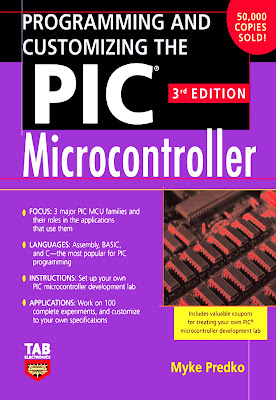
Programming And Customizing The Pic Microcontroller

https://blogger.googleusercontent.com/img/b/R29vZ2xl/AVvXsEiOXiIcdQAGKufTxF8wlUKiJRqwgZ5WU3EzMYc6Y5yjGWH2S_PB8qMnIpDhjUuTYOruCyY2nXM9KGfSKGNl9GnXR3_ehbL0bON6frDCaz6bJ-y87jiQjp0Fy3voOKlhajCXNFESCNfpF0c/s128/Programming%20And%20Customizing%20The%20Pic%20Microcontroller%20Myke%20Predko%203%C2%BA.jpg Programming And Customizing The Pic Microcontroller 
Myke Predko

Reseña

Tap into the latest advancements in PIC technology with the fully revamped Third Edition of McGraw-Hill's Programming and Customizing the PIC Microcontroller. Long known as the subject's definitive text, this indispensable volume comes packed with more than 600 illustrations, and provides comprehensive, easy-to-understand coverage of the PIC microcontroller's hardware and software schemes.
With 100 experiments, projects, and libraries, you get a firm grasp of PICs, how they work, and the ins-and-outs of their most dynamic applications.
Written by renowned technology guru Myke Predko, this updated edition features a streamlined, more accessible format, and delivers:
Concentration on the three major PIC families, to help you fully understand the synergy between the Assembly, BASIC, and C programming languages

Acceda a los últimos avances en tecnología de PIC con la edición totalmente renovada Tercera Programación McGraw-Hill y personalización del microcontrolador PIC. Conocida desde hace tiempo como texto definitivo del sujeto, en este volumen indispensable viene embalado con más de 600 ilustraciones, y provee información integral, fácil de entender la cobertura de hardware del microcontrolador PIC y los sistemas de software.
Con 100 experimentos, proyectos y librerías, obtenga una sólida comprensión de los PIC, cómo funcionan, y los pros y contras de sus aplicaciones más dinámicas. Escrito por el reconocido gurú de la tecnología Myke Predko, esta edición actualizada presenta un formato ágil, más accesible, y ofrece:
La concentración en las tres familias principales de PIC, para ayudarle a comprender plenamente la sinergia entre el ensamblador, BASIC y lenguajes de programación C

INDICE
  • Embedded Microcontrollers
  • The Microchip PIC Microcontroller
  • Software Development Tools
  • Programming PIC Microcontrollers
  • Emulators and Debuggers
  • The Microchip PIC MCU Processor Architecture
  • Using the PIC MCU Instruction Set
  • Assembly-Language Software Techniques
  • Basic Operating Features
  • Macro Development
  • Building and Linking
  • Bootloaders
  • Real-Time Operating Systems
  • Debugging Your Applications
  • PIC Microcontroller Application Design and Hardware Interfacing
  • PIC MCU Optional Hardware Features
  • PIC MCU Input and Output Device Interfacing
  • Motor Control
  • Practical PC Interfacing
  • PIC Microcontroller Application Basics
  • Projects
  • Appendix
  • Glossary
Consulta el Libro (9 MB) por:
Para los que usan Gestores de Descarga
http://adf.ly/LZ5yW
http://adf.ly/LZ5yX
http://adf.ly/LZ5yY
http://adf.ly/LZ5yZ

INDICE GENERAL
  • Embedded Microcontrollers. Microcontroller Types. Internal Hardware. Applications. Processor Architectures. Instructions and Software. Peripheral Functions. Memory Types. Microcontroller Communication. Device Packaging. Application Development Tools.
  • The Microchip PIC Microcontroller. Accessing the Microchip Web Site. PIC Microcontroller Feature Summary. Features Unique to the PIC Microcontroller. PIC Microcontroller Families.
  • Software Development Tools. Tools Overview. High Level Languages. Microchip MPLAB IDE.
  • Programming PIC Microcontrollers. Hex File Format. Code Protection. Parallel Programming. PIC ICSP Programmer Interface. Microchip Programmers. My Programmers. Third-Party Programmers.
  • Emulators and Debuggers. MPLAB ICE-2000. MPLAB REAL ICE. MPLAB ICD 2 Debugger. The Emu-II. Other Emulators.
  • The Microchip PIC MCU Processor Architecture. The CPU. Hardware and File Registers. The PIC Microcontroller’s ALU. Data Movement. The Program Counter and Stack. Reset. Interrupts. Architecture Differences.
  • Using the PIC MCU Instruction Set. Setting Up the MPLAB IDE Simulator with a Test Template. PIC MCU Instruction Types. The Mid-Range Instruction Set. Low-End PIC Microcontroller Instruction Set. PIC18 Instruction Set.
  • Assembly-Language Software Techniques. Sample Template. Labels, Addresses, and Flags. Subroutines with Parameter Passing. Subtraction, Comparing and Negation. Bit AND and OR. 16-Bit Operations. MulDiv, Constant Multiplication and Division. Delays. Patch Space. Structures, Pointers, and Arrays. Sorting Data. Interrupts. Reentrant Subroutines. Simulating Logic. Event-Driven Programming. State Machine Programming. Porting Code Between PIC Microcontroller Device Architectures. Optimizing PIC Microcontroller Applications. A Baker’s Dozen Rules to Follow That Will Help to Avoid Application Software Problems.
  • Basic Operating Features. Power Input and Decoupling. Configuration Fuses. OPTION Register. TMR0. Interrupt Operation. The Right PIC Microcontroller to Learn On.
  • Macro Development. PIC Microcontroller Assembly-Language Macros. The Difference Between Defines and Macros. The Assembler Calculator. Multiline C Macros. Conditional Assembly/Compilation. Using Defines and Conditional Assembly for Application Debug. Debugging Macros. Structured Programming Macros.
  • Building and Linking. Creating Linked Applications.
  • Bootloaders. Bootloader Requirements. Mid-Range Bootloaders. PIC18 Bootloaders.
  • Real-Time Operating Systems. Low-End and Mid-Range RTOSs. PIC18 RTOS Design.
  • Debugging Your Applications. Document the Expected State. Characterize the Problem. Hypothesize and Test Your Hypothesis. Propose Corrective Actions. Test Fixes. Release Your Solution. Debug: An Application to Test Your Debug Skills.
  • PIC Microcontroller Application Design and Hardware Interfacing. Requirements Definition. PIC Microcontroller Resource Allocation. Effective User Interfacing. Project Management. Power Management. Reset. Interfacing to External Devices.
  • PIC MCU Optional Hardware Features. Mid-Range Built-in EEPROM/Flash Access. TMR1. TMR2. Compare/Capture/PWM (CCP) Module. Serial I/O. Analog I/O. Parallel Slave Port (PSP). In-Circuit Serial Programming (ICSP).
  • PIC MCU Input and Output Device Interfacing. LEDs. Switch Bounce. Matrix Keypads. LCDs. Analog I/O. Audio Output. Relays and Solenoids. Asynchronous (NRZ) Serial Interfaces. Synchronous Serial Interfaces.
  • Motor Control. Dc Motors. Stepper Motors. R/C Servo Control.
  • Practical PC Interfacing. PC Software Application Development Tools. Serial Port. Parallel Port.
  • PIC Microcontroller Application Basics. Jumping Around. Some Basic Functions. Analog Input/Output. I/O with Interrupts. Serial I/O.
  • Projects. Low-End Devices. Mid-Range Devices. PIC18 Devices.
  • Appendix.
  • Resources. Microchip. Books to Help You Learn Moreabout the PIC Microcontroller. Useful Books. Recommended PIC Microcontroller Websites. Periodicals. Other Websites of Interest. Part Suppliers.
  • PIC Microcontroller Summary. Feature to Part Number Table. Instruction Sets. I/O Register Addresses. Device Pinouts.
  • Useful Tables and Data. Electrical Engineering Formulas. Mathematical Formulas. Mathematical Conversions. ASCII.
  • Miscellaneous Electronic Reference Information. Basic Electronic Components and Their Symbols. Test Equipment.
  • Basic Programming Language. PICBASIC.
  • C Programming Language. Common Library Functions. PICC Library Functions. Microchip C18 Library Functions.
  • Reuse, Return, and Recycle. Useful Snippets. Mykemacs.inc. Sixteen-Bit Numbers.
  • Glossary.
Related Posts Plugin for WordPress, Blogger...